Artificial intelligence is no longer a futuristic add-on in the contact centre. It is rapidly becoming the backbone of modern customer service, helping organisations respond faster, personalise every interaction, and support agents with real-time insights. By understanding how AI improves call center performance, companies can leverage it to enhance efficiency, reduce wait times, and empower agents without losing the human touch. When implemented thoughtfully, AI does not replace humans – it amplifies their capabilities.
As AI in the contact centre continues to evolve, organisations are increasingly adopting emerging technology solutions that streamline digital operations to improve performance and reduce operational bottlenecks. Integrating high-performance computing platforms for real-time customer analytics allows agents to respond faster and personalise interactions with more precision. On the marketing side, businesses are leveraging comprehensive online marketing strategies that increase customer engagement to ensure campaigns align with insights drawn from AI-powered data. Similarly, advanced digital marketing techniques designed to optimise customer journeys help teams deliver targeted messages at every stage of the buying cycle. Financial management within the contact centre is also becoming smarter, as organisations turn to strategies for integrating AI-driven insights into operational budgeting and finance planning to make data-backed decisions that improve ROI. By combining technology innovation, marketing intelligence, and financial oversight, AI in the contact centre empowers teams to deliver faster, more personalised, and consistently high-quality service while supporting long-term business growth.
Top 10 AI in the Contact Centre Software Solutions
AI in the contact centre is transforming the way businesses engage with customers, improve agent productivity, and optimize operations. With advanced analytics, natural language processing, and automation, AI solutions are no longer optional—they are essential for modern customer service. Here are the top 10 AI in the contact centre platforms that businesses are using today:
1. Bright Pattern
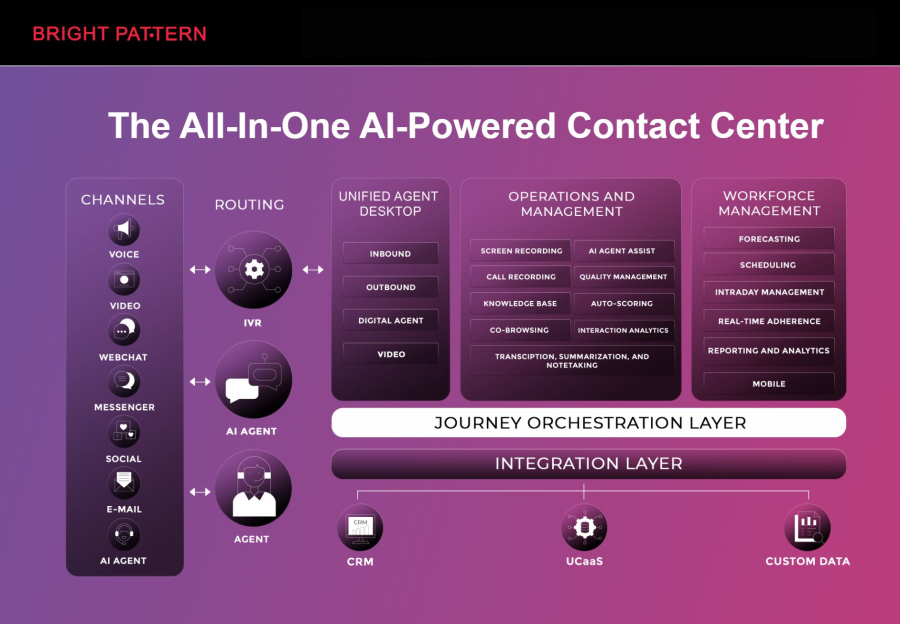
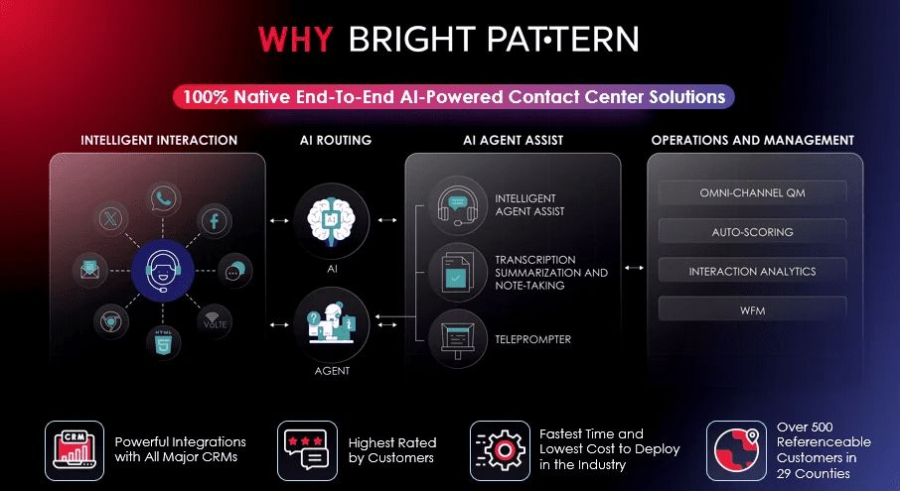
Bright Pattern is a leading provider of AI in the contact centre, helping organizations deliver seamless, personalized customer experiences. Its platform combines omnichannel communication, AI-powered automation, and intelligent routing to enhance agent performance and customer satisfaction.
Key features include:
- Omnichannel support for voice, chat, email, and messaging apps
- AI-driven agent assistance with real-time suggestions
- Automated workflows to reduce handling time
- Analytics dashboards for performance tracking
- Seamless CRM integrations to streamline operations
By implementing Bright Pattern, companies can reduce wait times, improve first-contact resolution, and make data-driven decisions that enhance both customer and agent experiences.
2. Genesys Cloud CX
A cloud-based solution that combines AI chatbots, predictive routing, and analytics to optimize customer interactions.
3. Five9
Offers AI-assisted dialing, predictive analytics, and real-time agent guidance to improve efficiency in contact centres.
4. Talkdesk
Provides an AI-powered contact centre platform with automation, speech analytics, and customer journey insights.
5. NICE inContact
Integrates AI-driven interaction analytics and automated workflows to improve service quality and operational efficiency.
6. Avaya OneCloud
A comprehensive contact centre solution using AI for virtual agents, real-time coaching, and predictive engagement.
7. RingCentral Contact Center
Offers cloud contact centre capabilities with AI-assisted routing, conversation analytics, and omnichannel support.
8. 8x8 Contact Center
Combines AI analytics, chatbots, and intelligent routing to enhance both customer experiences and agent productivity.
9. Cisco Contact Center
Provides AI-powered tools for customer sentiment analysis, workflow automation, and real-time agent guidance.
10. Amazon Connect
A scalable cloud contact centre that leverages AI for speech recognition, chatbots, and personalized customer experiences.
What Does AI in the Contact Centre Actually Mean?
AI in the contact centre refers to the use of technologies such as machine learning, natural language processing, and automation to improve how customer interactions are handled across channels.
In practical terms, this includes tools and capabilities such as:
- Virtual agents and chatbotsthat understand natural language and resolve common queries.
- Voicebots and IVR with speech recognitionthat guide callers to the right information or agent.
- Agent assist toolsthat surface real-time suggestions, knowledge articles, and next-best actions.
- AI-powered routingthat connects customers to the best agent or channel based on intent and profile.
- Sentiment and intent analysisthat interpret customer mood, urgency, and topics.
- Automated quality managementthat evaluates interactions at scale.
- Workforce forecasting and optimisationthat help you staff the right people at the right time.
Each of these elements brings advantages on its own, but the real power appears when they work together as part of a connected customer experience strategy.
The Business Case: Why AI Belongs in the Contact Centre
When leaders invest in AI for the contact centre, they are typically aiming for a combination of four strategic outcomes: better customer experience, more efficient operations, empowered employees, and deeper insight.
1. Faster, More Convenient Service for Customers
AI dramatically reduces friction for customers by providing instant, accurate responses on their preferred channels.
- 24/7 self-servicevia virtual agents and chatbots gives customers help whenever they need it, without waiting for opening hours.
- Immediate answers to routine questionssuch as order status, balance inquiries, password resets, or policy details.
- Fewer transfers and dead endsas AI-powered routing directs customers to the right queue, agent, or self-service path based on intent.
- Consistent experiencesacross phone, chat, email, and messaging channels, powered by the same AI understanding of customer questions.
The result is a smoother, faster journey that builds loyalty and reduces frustration.
2. Empowered Agents and Higher Job Satisfaction
AI is a powerful ally for human agents, removing repetitive tasks and surfacing relevant information when it matters most.
- Reduced busyworkas AI handles data entry, call summarisation, and basic lookups, freeing agents to focus on complex, high-value conversations.
- Real-time guidancewith suggested responses, prompts to verify key details, and alerts when customer sentiment changes.
- Instant access to knowledgeas AI searches across FAQs, policies, and documentation to provide the most relevant answer.
- Faster onboardingsince new agents can rely on AI support to fill knowledge gaps and follow standard processes.
When agents feel supported instead of monitored, AI becomes a trusted partner that helps them succeed, reducing burnout and improving retention.
3. Lower Costs and Higher Operational Efficiency
AI enables contact centres to handle more interactions without simply adding more headcount.
- Deflection of routine contactsto self-service, reducing the volume that reaches human agents.
- Shorter handle timesas AI removes manual steps, surfaces context, and automates after-contact work.
- Smarter workforce planningwith AI forecasts that take into account seasonal trends, historical data, and new patterns.
- Better first-contact resolutiondriven by accurate intent detection and knowledge recommendations.
By optimising how work flows through the contact centre, AI helps organisations maintain service quality even as demand grows or fluctuates.
4. Deeper Insight from Every Interaction
Traditional contact centres could only analyse a small sample of calls for quality and insight. AI changes that, enabling analysis at scale.
- Automated conversation analyticsacross 100% of interactions, not just a small subset.
- Sentiment and topic analysisthat reveals what customers care about and how they feel.
- Trend detectionto spot emerging issues, product feedback, or training needs before they escalate.
- Performance insightsthat help leaders coach agents and refine processes with objective data.
These insights feed back into product development, marketing, and operations, turning the contact centre into a strategic intelligence hub.
Key AI Capabilities Transforming the Contact Centre
AI is a broad category. Understanding the main capabilities available today helps you prioritise where to start and how to expand.
AI-Powered Virtual Agents and Chatbots
Modern virtual agents go far beyond scripted chatbots. Using natural language understanding, they can:
- Interpret free-form questions in everyday language.
- Ask clarifying questions to narrow down a request.
- Authenticate customers using secure workflows.
- Complete end-to-end tasks such as booking, cancellations, or updates.
- Hand off to a human agent with full context when needed.
When designed around clear use cases and integrated with back-end systems, virtual agents can resolve a significant portion of interactions with high satisfaction.
Agent Assist and Co-Pilot Experiences
Agent assist tools bring the power of AI directly into the live conversation, whether by phone, chat, or messaging. They typically provide:
- Real-time transcriptionof voice calls so agents can review details as they speak.
- Suggested replies and next-best actionsbased on the customer’s intent and history.
- Relevant knowledge snippetspulled from documentation and previous cases.
- Compliance promptsto ensure required disclosures or steps are never missed.
These co-pilot style experiences help every agent, regardless of tenure, deliver consistent, high-quality support.
Intelligent Routing and Personalisation
AI-driven routing goes beyond simple skills-based rules. By combining customer data, interaction history, and real-time intent, it can:
- Match customers with agents who have the right skills and experience for the specific query.
- Prioritise high-value customers or urgent issues without manual intervention.
- Route some interactions to self-service flows when AI predicts a quick resolution.
- Support personalised offers or retention strategies based on churn risk or lifetime value signals.
This type of routing increases first-contact resolution and creates experiences that feel tailored rather than generic.
Quality Management and Coaching at Scale
AI-powered quality management solutions can automatically evaluate interactions using consistent criteria. They can:
- Score every call or chat on compliance, empathy, accuracy, and process adherence.
- Flag potential escalations or issues that need human review.
- Identify best-practice calls to use as training examples.
- Highlight specific coaching opportunities for each agent.
This transforms quality monitoring from a limited sampling exercise into a rich, data-driven coaching programme.
Workforce Management and Forecasting
AI can enhance workforce management by learning from historical patterns and real-time data. Typical capabilities include:
- Accurately forecasting contact volumes across channels.
- Recommending optimal staffing schedules to meet service level targets.
- Adjusting forecasts as new data comes in, such as promotions, outages, or seasonality.
- Balancing agent preferences with operational needs to improve engagement.
The outcome is a better match between demand and capacity, with less overtime, fewer idle periods, and a smoother agent experience.
AI Use Cases Across the Customer Journey
AI can support customers at every stage of their journey, from discovery to loyalty. Mapping use cases to each stage helps you prioritise where AI will make the biggest impact.
Journey Stage | AI Use Cases | Key Benefits |
Pre-Sales and Onboarding | Virtual product advisors, FAQ chatbots, proactive outreach | Faster answers, higher conversion, smoother onboarding |
Everyday Service | Self-service for common tasks, intelligent routing, agent assist | Shorter wait times, more first-contact resolutions |
Issue Resolution | Real-time sentiment analysis, escalation prediction, co-pilot tools | Lower churn, better recovery, calmer conversations |
Retention and Loyalty | Churn risk models, personalised offers, post-interaction surveys | Higher loyalty, better lifetime value, targeted retention |
Designing an AI-Enabled Contact Centre: Practical Steps
Moving from concept to reality does not have to be overwhelming. A structured approach helps ensure that AI investments align with business outcomes and deliver clear value.
1. Start with Clear Objectives
Before selecting tools or technologies, define what success looks like. Common objectives include:
- Reducing average handle time while maintaining quality.
- Increasing self-service resolution rates.
- Improving customer satisfaction or net promoter scores.
- Reducing agent attrition through better support and coaching.
- Expanding service hours without a proportional increase in cost.
These goals will shape which AI capabilities you prioritise and how you measure impact.
2. Identify High-Impact Use Cases
Look at your current interaction data to identify where AI can make a visible difference. Useful signals include:
- High-volume, repetitive inquiries that follow predictable steps.
- Bottlenecks where customers wait or get transferred frequently.
- Areas where agents often search for information or ask for help.
- Processes that are critical for compliance and consistency.
Each use case should be specific, measurable, and aligned with your objectives, such as“deflect password reset calls to self-service by using a secure virtual agent”rather than a vague aim like“use AI for customer service”.
3. Involve Agents Early and Often
Agents are at the heart of the contact centre. Involving them in AI planning and design yields better results and stronger adoption.
- Ask agents where they spend the most time on manual tasks.
- Gather ideas about prompts, knowledge snippets, and workflows that would help them.
- Invite experienced agents to test early prototypes and provide feedback.
- Communicate that AI is there to support them, not to replace them.
This collaborative approach builds trust and surfaces practical improvements that might otherwise be missed.
4. Pilot, Measure, and Iterate
Instead of rolling out AI everywhere at once, start with a focused pilot. For each pilot:
- Define clear success metrics, such as containment rate, handle time, or satisfaction scores.
- Run the pilot with a specific queue, region, or customer segment.
- Collect both quantitative data and qualitative feedback from agents and customers.
- Fine-tune models, conversation flows, and training materials based on what you learn.
This controlled approach reduces risk and helps you build a library of proven AI components that can be scaled confidently.
5. Integrate AI with Existing Systems
AI delivers the most value when it is connected to your core systems and data. Consider how your AI solutions will integrate with:
- Your customer relationship management platform.
- Ticketing and case management tools.
- Knowledge bases and document repositories.
- Telephony and omnichannel routing platforms.
- Workforce management and reporting solutions.
Thoughtful integration ensures that AI has the context it needs and that agents see a unified view of the customer, rather than juggling multiple disconnected tools.
Ensuring Responsible and Trustworthy AI
While this guide focuses on benefits, maintaining trust is essential when bringing AI into customer interactions. Organisations can strengthen trust by following a few core principles.
Transparency with Customers and Agents
- Make it clear when customers are interacting with an AI system, and provide an easy option to reach a human.
- Explain to agents how AI-driven recommendations are generated and how their data is used.
Clarity builds confidence and helps both customers and employees feel in control.
Data Protection and Security
- Follow appropriate data protection regulations for your regions and industries.
- Limit access to sensitive information based on roles and responsibilities.
- Review how AI tools store and process interaction data, and apply robust security standards.
Strong safeguards not only protect your organisation but also reinforce your brand as a trustworthy partner.
Continuous Monitoring and Improvement
- Regularly review AI performance to ensure accuracy, fairness, and relevance.
- Update knowledge content and conversation flows as products, policies, or customer needs change.
- Monitor for unintended consequences, such as confusing responses or overly strict automation.
AI should not be a set-and-forget investment. Ongoing optimisation keeps it aligned with your goals and your customers’ expectations.
Real-World Success Patterns
Across industries, a few common success patterns stand out for organisations that have adopted AI in the contact centre. While each journey is unique, you can leverage these patterns as guiding principles.
- Focus on journeys, not just channels.Successful teams design AI around end-to-end customer outcomes, such as“resolve billing confusion”, rather than isolated touchpoints.
- Prioritise quick wins.High-volume, low-complexity interactions, such as order tracking or appointment reminders, are ideal starting points that quickly demonstrate value.
- Blend automation with a human safety net.The most effective implementations combine AI self-service with easy access to empathetic human agents.
- Invest in people and change management.Training, communication, and clear career paths help agents embrace AI as an opportunity to develop higher-value skills.
- Use insights beyond the contact centre.Organisations that feed AI-driven interaction insights into product, marketing, and operations unlock broader business improvements.
Positioning Your Contact Centre for the Future
Customer expectations continue to rise. They want immediate responses, seamless transitions between channels, and support that understands their history and preferences. AI is a powerful way to meet these expectations, while also creating a more efficient and engaging environment for your agents.
By combining intelligent automation with human empathy, your contact centre can evolve from a cost centre into a strategic advantage. The journey starts with a clear vision, thoughtful use cases, and a commitment to ongoing learning.
When you put AI to work in the contact centre, you are not just adopting a new technology. You are reshaping how your organisation listens, responds, and builds lasting relationships with every customer you serve.
